


My insulin-to-carb ratio is wrong more often than I want to admit.
Not because the math is wrong. Because the assumption is wrong: that my sensitivity is stable.
I used to treat my insulin-to-carb ratio like gospel.
1:10. That was my number. Endocrinologist approved. Tested and refined over months. If I ate 50 grams of carbs, I took 5 units. Simple math. Clean system.
Except it kept failing.
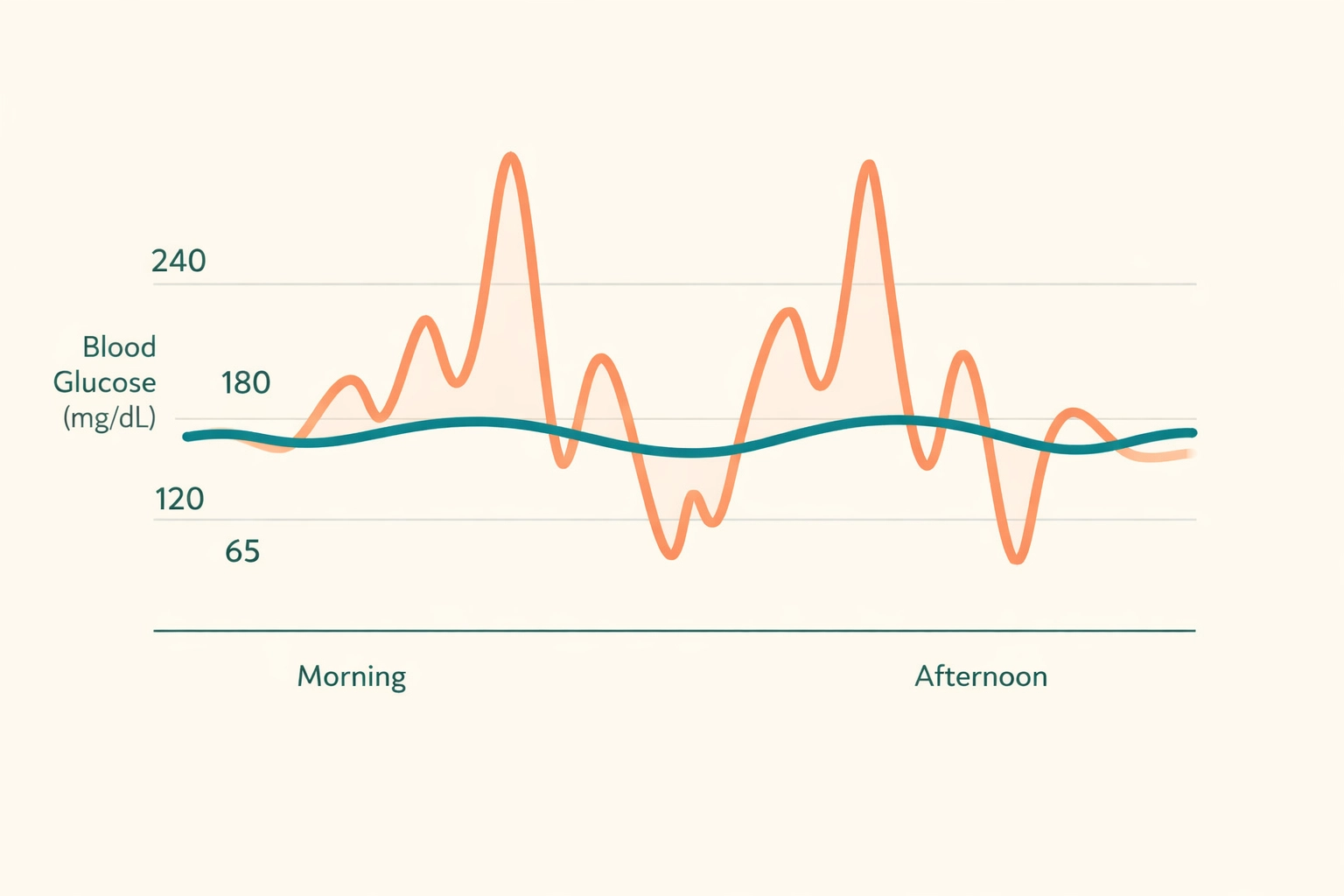
Same breakfast. Same bolus. Monday I'd be at 110 two hours later. Wednesday I'd spike to 240. Friday I'd crash to 65.
And every time it went sideways, I assumed I screwed up. Miscounted carbs. Forgot the banana was bigger than usual. Didn't pre-bolus enough. The usual suspects.
For years, I kept adjusting the ratio. Tightening it. Loosening it. Testing it again. Convinced that if I could just nail down the perfect number, everything would work.
It never did.
Three days in a row, I ate the exact same thing for lunch. Down to the gram. Weighed everything. Same timing. Same insulin dose. Same everything.
Day 1: Perfect flatline at 120.
Day 2: Spiked to 210 and stayed there for three hours.
Day 3: Dropped to 70 within an hour and I had to eat glucose tabs just to stay functional.
If ratios are the answer, that should not happen.
And if you've lived with Type 1 long enough, you know exactly what happens next. You start second-guessing everything. You tweak the ratio again. You wonder if your CGM is broken. You recalculate the carbs for the fifth time even though you know you counted them right.
Then you start to think maybe you're just bad at this.
Your insulin-to-carb ratio is not a source of truth. It's a starting point.
A snapshot of how your body responded on average under specific conditions you probably weren't tracking at the time.
What you ate matters. But so does how you slept. Whether you're stressed. If you exercised yesterday. The walk you didn't take after lunch. The meeting that spiked your cortisol. The cold you barely noticed but your body is definitely noticing.
All of that changes insulin sensitivity. And when sensitivity changes, your ratios effectively change too.
Not because you did something wrong. Because your body isn't a spreadsheet.
What changed for me wasn't finding a better number. It was realizing I was asking the wrong question.
Instead of "What's my ratio?" I started asking:
"Why did I spike today but not yesterday?"
"What's different about the mornings this happens?"
"Is this actually a food problem, or is it something else?"
"Is there a pattern here, or am I reacting to noise?"
And when you do that, something shifts. You stop treating every weird day like a personal failure. You start treating it like information.
You stop rebuilding your entire system every time you have a bad graph. You start looking for the actual variables that matter.
Sleep quality. I need 20-30% more insulin the day after I sleep poorly. Every time. It's not about the food. It's about cortisol wrecking my sensitivity overnight.
Stress. A frustrating work call can send my blood sugar up 40 points without eating anything. Not because I did something. Because my body dumped glucose in response to adrenaline.
Activity. The day after a long workout, my insulin needs drop. Not during the workout: after. Because my muscles are pulling glucose out of my bloodstream to recover.
Fat and protein. High-fat meals delay digestion. I used to spike 4-5 hours after eating nuts because the fat slowed everything down, but I'd already corrected for what looked like a high an hour earlier. Then I'd crash. Then I'd overtreat the low. Chaos.
Meal timing. Eating the same meal at 7am vs. 7pm hits different because my insulin sensitivity changes throughout the day. Dawn phenomenon is real, and it doesn't care about your carb count.
These aren't edge cases. They're the baseline reality of living with Type 1.
And if you're only tracking food and insulin, you're flying blind.
Most people look at a bad day and ask: "What did I eat? What did I dose? What ratio should I change?"
But food and insulin are only two variables in a much larger system.
So you keep turning those two knobs, wondering why nothing stabilizes. Because the real driver is somewhere else.
That's why diabetes feels like gaslighting. You do the same thing. You get a different result. And you blame yourself for not controlling an equation you don't actually have all the variables for.
When I stopped fixating on ratios and started observing everything: sleep, stress, activity, meal timing, not just carbs: the patterns became obvious.
Not perfect. Not predictable down to the minute. But obvious enough that I stopped feeling like I was guessing all the time.
I still use my ratio. It's still useful. But now I adjust based on context, not just math.
If I slept like garbage, I add 20% more insulin to my breakfast bolus. If I worked out yesterday, I reduce my lunch dose. If I'm stressed, I expect to need more corrections throughout the day.
I'm not chasing perfection. I'm tightening the range. Fewer wild swings. More predictability.
And that predictability is what actually lets you relax a little. Because you're not constantly bracing for the next surprise.
When you stop worshipping your settings, you stop spiraling.
You stop "fixing" things that aren't broken. You stop thinking you're bad at this just because your body changed. You stop making big changes based on one chaotic day.
And you start building a system that adapts to real life instead of pretending real life doesn't exist.
Ratios still matter. Basals still matter. Carb counting still matters.
But they're tools. Not truth.
The truth is in the patterns. In understanding why yesterday was chaos and today was smooth. In seeing the actual variables that drive your insulin needs instead of just blaming yourself when the math doesn't work.
That's the shift. From trusting a number to trusting what your body is actually telling you.
And once you make that shift, diabetes gets a lot less exhausting.


